Accounting for Disruption
This is a short summary of a theme that stood out to me from the Innovation Account workshop led by David Binetti on day one of Lean Startup Conference 2014.
David introduced the Three Horizons model, developed by McKinsey&Company, as a strategy for companies to manage their innovation pipeline.
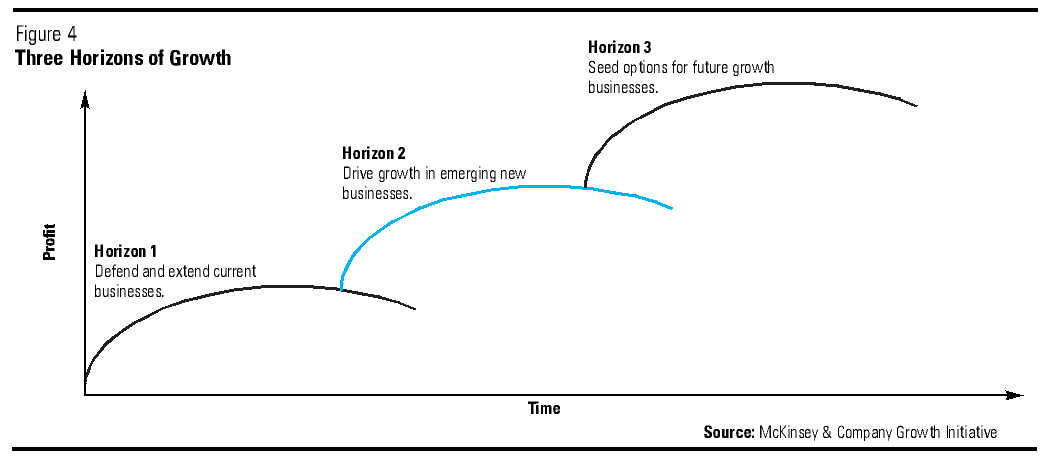
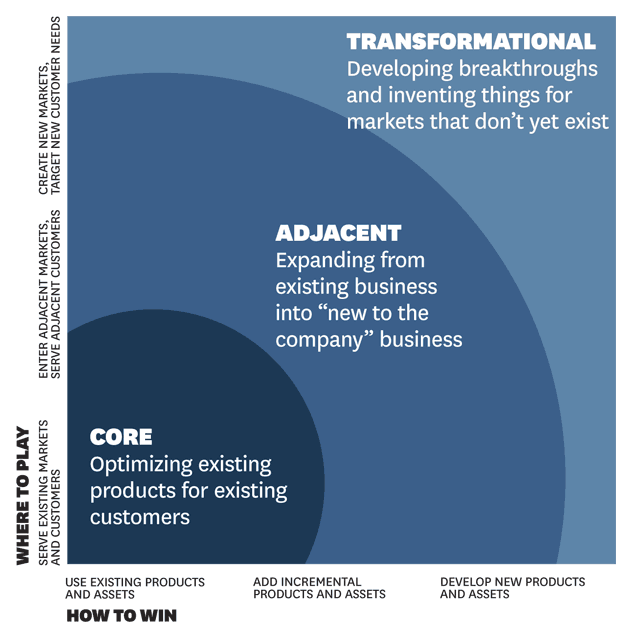
There is a ton of information out on the web about this framework, including a similar model we use at my company, the Innovation Ambition Matrix from the Monitor Group.
The point David made was that traditional accounting metrics can be used in the first two types of innovation projects (H1 and H2), but Horizon 3 requires different metrics (different everything really, but maybe that’ll be another post sometime).
OK, so what metrics?
Well the answer is in the other two horizons. The goal of H3 projects is to become H2 and then H1 projects. Obvious right? But eyeopening for me.
One aside that I had never thought about was that startups are H3 projects without the presence of H2 and H1. They do however have H2 and H1 responsibilities to worry about, like supporting a family or keeping a marriage together. So while startups are free from many of the roadblocks in traditional organizations, they still have to grow and produce value in a timely manner, or move from H3 to H2 and H1.
David proposed the following framework for measurement.
H3: Reduce risk
H2: Identify growth engine
H1: Create value
Since we know H3 projects need to grow up sometime, the goal is to reduce risk, BUT ALSO show progress toward growth and value. The point when a project can move from H3 to H2, is when you’ve sufficiently reduced the risk and shown your solution has the potential to grow and provide value. David calls this “optionality,” or when an investor or organization has the option to continue. This image came to mind as he talked about the concept.
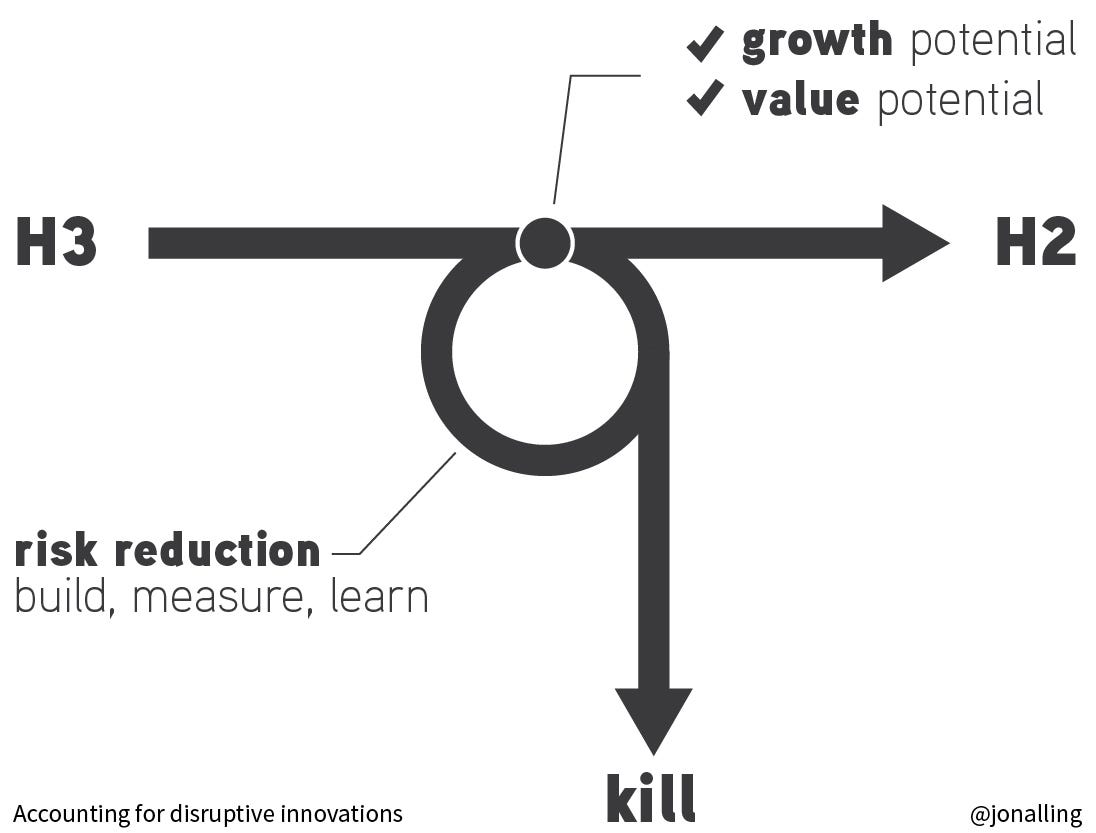
Risk is reduced by using the build, measure, learn loop. By testing. You can’t reduce risk by buying a trend report (another eyeopening moment). They are great for ideas, but as David says “risk can only be validated in the market.” The metrics to aim for with those loops are indications toward growth and value. Plenty of time is spent in The Lean Startup on growth engines, so David didn’t go into great depth. But we did spend some more time on Value.
David says VALUE is BENEFIT over COST. What is a customer willing to give up to get some benefit? Do they give up their time, or their privacy, or better yet, spend actual money? But at the end of the day, it comes down to the ability to generate profits, so earn actual money. List of users can be valuable, and show promise, but a paying customer is always best. Should be plenty more to learn on this topic throughout the rest of the conference, so I’m looking forward to continuing this story.